ALLHALLOWTIDE: The Truduum of Hallow Tide
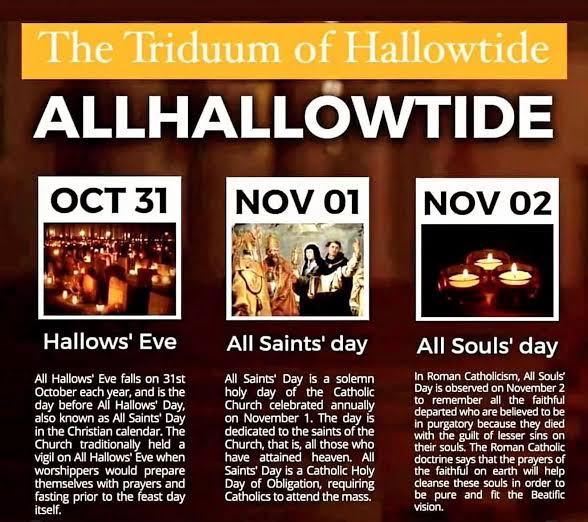
Hallowtide, also known as Allhallowtide or Hallowmas, is the traditional Catholic observance spanning the three days from October 31 to November 2. It forms a triduum centered on the saints in heaven and the faithful departed, serving as a period of remembrance for the dead, reflection on the Communion of Saints, and contemplation of the last things: death, judgment, heaven, and hell.
The period opens on October 31 with All Hallows’ Eve, commonly called Halloween. This is the vigil of the feast that follows. The name itself derives from older English: “hallow” means holy or saint, and “een” is a shortened form of “even,” meaning evening. Thus Halloween simply designates the evening before the feast of all the saints and prepares the faithful for the solemnity of the next day.
November 1 is All Saints’ Day, or All Hallows’ Day. This solemnity honors every saint in heaven, including both those formally recognized by the Church and the countless unknown holy men and women known only to God. It is ordinarily a holy day of obligation, though local practice can vary according to the day of the week on which it falls. The Gospel reading for the day is drawn from the Beatitudes.
The observance of All Saints Day has deep historical roots. Early Christians commemorated groups of martyrs on common days when individual anniversaries became impractical. A feast of all martyrs was kept on May 13 in connection with the dedication of the Roman Pantheon to the Virgin Mary and all martyrs in the early seventh century. In the eighth century Pope Gregory III linked a November 1 celebration to the dedication of a chapel in St. Peter’s Basilica, and Pope Gregory IV later extended the date more widely throughout the Western Church.
November 2 is All Souls’ Day, the Commemoration of All the Faithful Departed. On this day the Church offers special prayers, Masses, and acts of charity for the souls of those who died in the grace and friendship of God yet still undergo purification in purgatory before entering the fullness of heaven. Catholic teaching holds that the prayers and offerings of the living can assist these souls. Visiting a cemetery and praying for the dead during the first days of November can obtain a plenary indulgence under the ordinary conditions. November as a whole is traditionally regarded as the Month of the Holy Souls.
Taken together, the three days express the Communion of Saints, the belief that the Catholic Church as the Mystical Body of Christ is united across three states: the Church Militant, consisting of the faithful still living on earth and striving for holiness; the Church Triumphant, comprising the saints already in heaven; and the Church Suffering, the souls undergoing purification. Hallowtide is therefore less a meditation on death alone than an affirmation of faith in Jesus Christ as Savior and Redeemer, the hope of eternal life, the intercession of the saints, and the mercy of God. It invites the practice of memento mori—the reminder that one must die—so that life may be lived in light of that reality. An octave once prolonged the celebration for eight days, though that extension was discontinued in the mid-twentieth-century liturgical reforms.
In practice, Catholics mark the days by attending Mass, reading the lives of the saints, praying the Office of the Dead, visiting graves (often with candles and flowers), and offering prayers or sacrifices for the departed. Medieval customs such as souling, in which people went from house to house seeking soul cakes in exchange for prayers, contributed to later popular practices. While modern secular Halloween features costumes, carved pumpkins, and trick-or-treating drawn from various European folk traditions brought by immigrants to America, the name of the season and its liturgical core remain Christian. Hallowtide thus stands as a season that binds the living, the saints in glory, and the souls in need of prayer around the central Christian hope of the resurrection and eternal life with God.


