St. John Henry Newman | Vision of purgatory
🌊 “I Enfold Thee”: St. John Henry Newman’s Vision of Purgatory as a Lake of Love
“Softly and gently, dearly ransom’d soul,
In my most loving arms I now enfold thee.”
— St. John Henry Newman, The Dream of Gerontius
✝️ A Saint of Wisdom and Light
The 38th Doctor of the Church, St. John Henry Newman, stands as a luminous witness to divine truth and wisdom. Once an Anglican clergyman, his relentless search for truth led him to the Catholic Church — a journey marked by prayer, study, and great humility.
Newman’s intellect and spirituality were immense. His collected writings span 31 volumes, filled with theological insight and profound meditations that continue to guide the Church today. Yet his heart was not only that of a theologian, but of a lover of God who sought to understand the mystery of divine love.
The Book of Wisdom tells us:
“Wisdom is resplendent and unfading… readily perceived by those who love her, and found by those who seek her.” (Wisdom 6:12)
Newman’s life was a living pursuit of this wisdom — not as mere knowledge, but as a spiritual seeing, the ability to perceive Christ’s presence in all things, and to recognize that every joy and sorrow are part of His redemptive plan.
🕊️ The Poet of the Soul’s Journey
Newman was not only a theologian but a poet of eternity. His most famous poem, “The Dream of Gerontius,” unfolds like a mystical vision — a journey of the soul after death.
It begins with the moment of Gerontius’ passing, then follows him as he awakens beyond the veil of time, guided by his guardian angel. He is not abandoned to fear or confusion; he is surrounded by the prayers of his friends, the Mass offered for him, and the gentle protection of his angelic guide.
The poem reflects the deep question every human heart asks:
What happens to me when I die?
For Newman, the answer is radiant with hope: in Christ, every soul’s journey is guided toward love and purification, until it is ready to see God face-to-face.
👿 The Mockery of the World
Newman’s age — like ours — was haunted by doubt and darkness. The Victorian world, proud of science and reason, often dismissed faith as superstition. In the poem, Newman captures this tension through a chilling moment: as the soul of Gerontius passes toward judgment, he hears demons mocking Christ and His followers.
“Virtue and vice,
A knave’s pretence,
’Tis all the same; ha! ha!
Dread of hell-fire,
Of the venomous flame,
A coward’s plea.”
To them, belief in the afterlife is a coward’s refuge, a myth for the weak. Yet in the face of their laughter, Gerontius’ guardian angel whispers calm and consolation, shielding him from despair with divine tenderness.
Even in judgment, the soul is not alone — the mercy of God enfolds it through the ministry of the angels.
🌅 Newman’s Vision of Purgatory — The Lake of Love
While many theologians described purgatory in terms of fire and pain, St. John Henry Newman offered a vision of gentle cleansing through divine love.
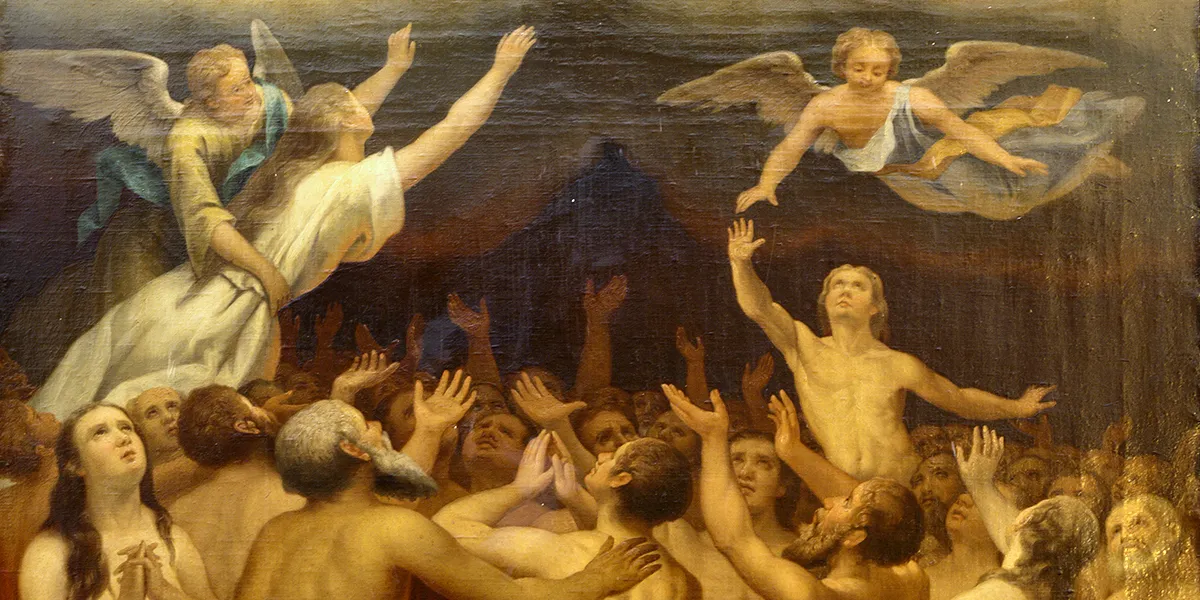
In The Dream of Gerontius, purgatory is revealed not as a place of torment, but as a tranquil, luminous lake — a baptismal pool of mercy and purification. Here, the soul is washed, healed, and prepared for Heaven.
The guardian angel explains that before entering the full glory of God’s presence, the soul must be cleansed of the smallest stains of sin — not as punishment, but as transformation in love:
“Softly and gently, dearly ransom’d soul,
In my most loving arms I now enfold thee,
And, o’er the penal waters, as they roll,
I poise thee, and I lower thee, and hold thee.”
This imagery reveals Newman’s profound understanding of purgatory — not as a prison of flames, but as a lake of mercy where divine love itself becomes the cleansing water.
He imagines the soul longing for this purification, drawn irresistibly toward the vision of God but unable yet to bear the fullness of His glory.
The angel explains:
“There will I soothe thee to thy heart’s content,
And charm thee with the music of the blest;
There will I bathe thee in the holy font,
And bathe thy spirit in eternal rest.”
Here, purgatory is not punishment — it is love at work. It is the soul’s willing surrender to purification, a final act of love before entering eternal union with God. The angel’s words are maternal, tender, protective — echoing Our Lady’s own care for souls.
💫 The Communion of Love: Earth, Heaven, and the Souls in Between
Newman also reminds us that the souls in purgatory are not forgotten. They are sustained by the prayers of the Church on earth and comforted by the saints in Heaven. The poem continues:
“Angels, to whom the willing task is given,
Shall tend, and nurse, and lull thee, as thou liest;
And Masses on the earth, and prayers in Heaven,
Shall aid thee at the Throne of the Most Highest.”
This beautiful passage reveals the mystical unity of the Church — the Church Militant (on earth), the Church Suffering (in purgatory), and the Church Triumphant (in Heaven).
Every Mass, every Rosary, every prayer for the dead becomes a bridge of mercy, easing the soul’s journey and hastening its entry into Heaven’s joy.
🔥 Fire or Water — Two Faces of the Same Love
In his letters and sermons, Newman explained that whether purgatory is described as fire or water, both symbolize the consuming and cleansing love of God.
“The fire of purgatory,” he wrote, “is the burning of the soul with the desire of its God.”
It is not God who inflicts pain, but love itself that purifies. The soul, once bound to earthly attachments, feels the sorrow of its separation — yet that sorrow is holy, because it comes from love’s longing.
Thus, the fire is love. The water is love. Purgatory is the triumph of love over imperfection, where mercy completes what repentance began.
🌈 Hope Beyond the Grave
To believe in purgatory is to believe in the patience of God.
He does not abandon His children at death, but continues to sanctify them until they are ready for eternal joy.
Christ’s cross has already accomplished our redemption — purgatory is simply the final embrace of that redemption, when all that is unworthy of Heaven is gently burned or washed away in love.
“We do not grieve like others who have no hope.” (1 Thess. 4:13)
For Christians, death is not the end. It is the doorway to transformation.
Our prayers, sacrifices, and Masses for the souls in purgatory are acts of love — uniting Heaven and earth in one song of mercy.
🙏 Prayer for the Holy Souls in Purgatory
Eternal Father,
I offer Thee the Most Precious Blood of Thy Divine Son, Jesus,
in union with the Masses said throughout the world today,
for all the Holy Souls in Purgatory,
for sinners everywhere,
for sinners in the universal Church,
and those in my own home and within my family. Amen.
🌹 Reflection
💫 Do I see purgatory as punishment, or as love completing its work in me?
💫 Do I pray daily for the souls of the departed, trusting that my prayers truly help them?
💫 Can I surrender now to the gentle purification of daily crosses, so that my soul may rest in peace when my hour comes?
🕊️ Final Thought
St. John Henry Newman’s vision of purgatory invites us to look beyond fear and to see God’s mercy in every stage of existence.
In his poetic imagination, we are not thrown into fire but lowered tenderly into a lake of love — bathed, healed, and enfolded in angelic arms.
May we, too, trust that when our earthly journey ends, a loving Angel will whisper to us:
“Softly and gently, dearly ransom’d soul,
In my most loving arms I now enfold thee.”